
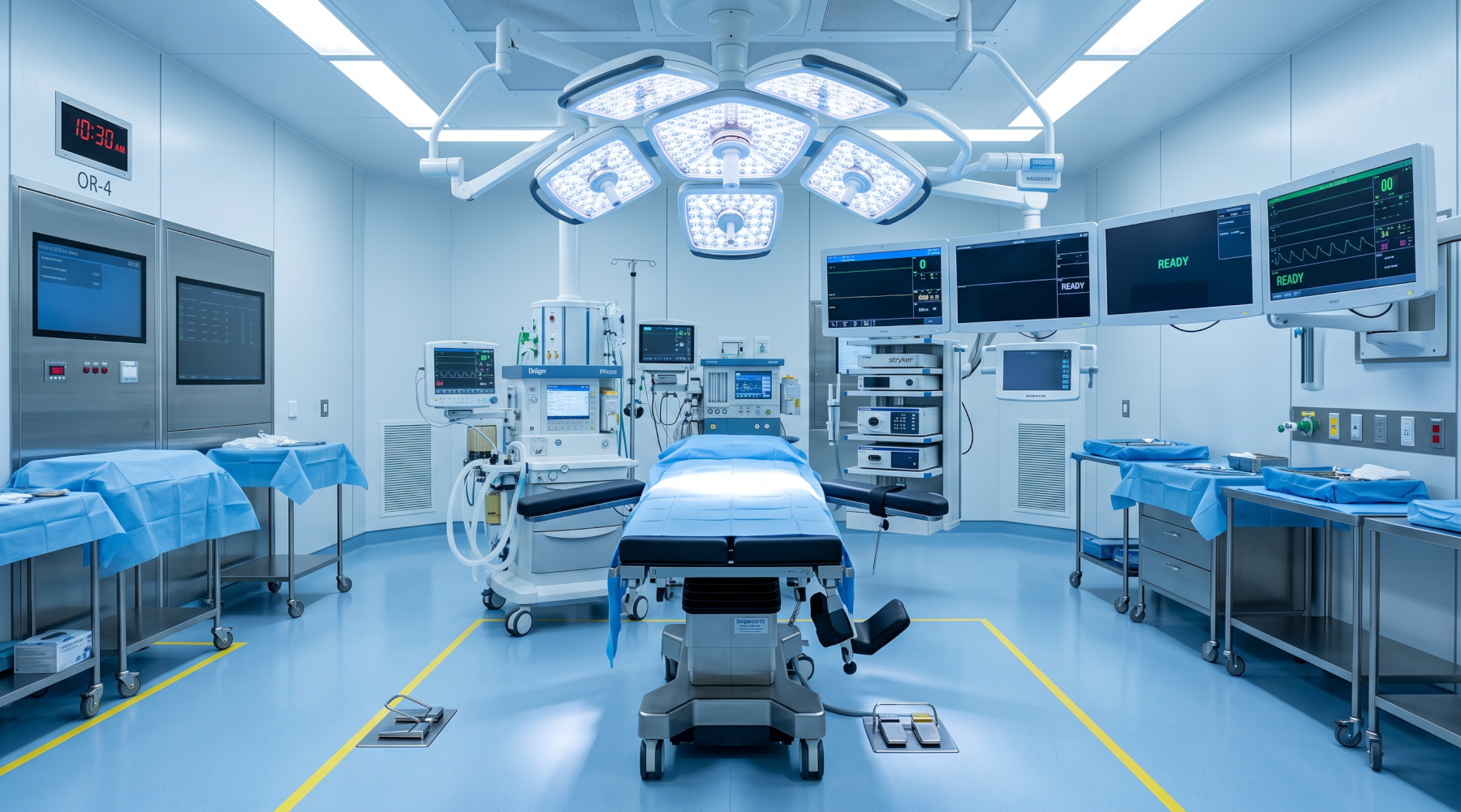

The Operating Room (OR), also known as the operating theater, is the most critical and complex environment within any healthcare facility. It is where life-saving interventions take place, where surgical precision meets advanced technology, and often, where a significant portion of a hospital's revenue is generated. Equipping an OR is a high-stakes endeavor that requires meticulous planning, an understanding of clinical workflows, and zero compromise on safety and sterility.
Whether you are building a new surgical center or upgrading an existing department, this comprehensive guide by Mak Medikal breaks down the essential equipment required for a state-of-the-art Operating Room, and how turnkey solutions can simplify the integration of these complex systems.
Before a single scalpel is brought into the room, the infrastructure of the OR must be flawless. This involves complex electromechanical engineering that is seamlessly integrated into the room's architecture.
Laminar Air Flow (HVAC) Systems: Airborne pathogens are the enemy of open surgery. ORs require specialized HVAC systems with HEPA filters that create positive pressure and laminar (unidirectional) airflow directly over the operating table, pushing microscopic contaminants away from the sterile field.
Medical Gas Pipeline Systems: The OR must have instant, uninterrupted access to medical gases, including Oxygen (O2), Nitrous Oxide (N2O), Medical Air, and Medical Vacuum. These are usually delivered via ceiling-mounted Surgical Pendants.
Ceiling Pendants (Booms): Trailing cables and hoses on the floor are a massive safety hazard. Ceiling pendants are articulated arms suspended from the roof that deliver medical gases, electrical power, and data connections right to the surgical and anesthesia teams, keeping the floor completely clear.
The selection of devices dictates the types of surgeries a hospital can safely perform. Here is the definitive checklist for a modern OR:
The surgical table is the literal foundation of the operation. Modern tables are electro-hydraulic, allowing for smooth, precise adjustments (height, lateral tilt, Trendelenburg, and reverse Trendelenburg) via remote control.
Key Feature to Look For: Radiolucency. For orthopedic, neurosurgical, or vascular procedures, the table top must be made of carbon fiber or radiolucent materials to allow X-Rays (from a C-Arm) to pass through without interference.
Visibility is everything for a surgeon. Modern ORs utilize advanced LED Surgical Lights mounted on ceiling suspension arms.
Key Features: They must provide shadowless illumination (using multiple light heads to eliminate shadows cast by the surgeon's head or hands), emit minimal heat to prevent tissue drying, and offer adjustable color temperatures to accurately render true tissue colors (high CRI - Color Rendering Index).
The anesthesia machine is a highly complex life-support system. It precisely mixes medical gases and volatile anesthetic agents to keep the patient unconscious and pain-free, while simultaneously acting as a mechanical ventilator to breathe for the patient during the procedure. Modern workstations include integrated patient monitoring (capnography, BIS monitoring for depth of anesthesia) and automated safety features to prevent hypoxic mixtures.
Electrosurgical units use high-frequency electrical currents to cut tissue and simultaneously coagulate blood vessels (hemostasis) to stop bleeding. An OR must be equipped with modern ESUs capable of both monopolar and bipolar modes, and ideally, advanced vessel sealing technology.
While the anesthesia machine has its monitors, a dedicated high-acuity patient monitor is essential to track ECG, invasive and non-invasive blood pressure, SpO2, and temperature in real-time, continuously transmitting data to the hospital's central server.
Depending on the hospital's specialty (Orthopedics, Neurosurgery, Gynecology), additional high-tech equipment is integrated:
C-Arm Fluoroscopy: A mobile X-Ray machine shaped like a 'C' that provides real-time, high-resolution imaging during surgery (crucial for orthopedics and stent placements).
Surgical Microscopes: Essential for neurosurgery, ophthalmology, and microsurgery, providing extreme magnification and brilliant illumination of the surgical field.
Endoscopy and Laparoscopy Towers: For minimally invasive surgeries, featuring high-definition cameras, cold light sources, insufflators, and high-res medical grade monitors.
Surgical Instrument Sets: High-grade, rust-resistant stainless steel instruments (scalpels, forceps, retractors, scissors) customized into specific sets for General Surgery, ENT, Urology, etc.
Procuring all these devices from different vendors can lead to integration failures—for instance, surgical lights colliding with ceiling pendants, or anesthesia machines incompatible with the hospital's gas outlets.
Mak Medikal specializes in Turnkey Operating Room Setups. We approach the OR as a single, cohesive ecosystem. Our biomedical engineering team designs the layout using 3D modeling, ensuring perfect spatial harmony. We supply perfectly matched, CE-certified equipment, manage the installation of ceiling suspensions and gas pipelines, calibrate all electronic devices, and provide comprehensive clinical training to your surgical staff. By sourcing your entire OR through Mak Medikal, you guarantee technological synergy, optimized costs, and a surgical theater ready to save lives from day one.
A comprehensive guide to setting up a hospital radiology department. Discover key imaging devices like MRI, CT, X-Ray, Ultrasound, and infrastructure needs.
Explore the ultimate guide to Operating Room (OR) equipment. Learn about surgical tables, anesthesia machines, lighting, and turnkey OR setup solutions.
Discover why Turkey is the leading hub for medical equipment export. Explore turnkey hospital solutions, logistics to Africa & MENA, and top device categories.